
Systematics Solutions

Product Designer — Mobile App Design
Systematics Solutions makes things you can hold — retail displays, packaging, fixtures built for national brands. Their website didn't look like it. It read like documentation, not proof of craft, and buyers had to dig through paragraphs to find out if this company could actually build what they needed. I owned design and implementation of the site in 2026, working directly with the client's president and marketing stakeholders. Scope covered UX research, content restructuring, information architecture, wireframes, high-fidelity UI, a component library, motion and interaction design, and building the entire site in Framer — no handoff, because I built it myself.
Service
Mobile App Design
UX & IA
UI Design
Design System
Interaction Design
Category
B2B
Internal Tool
Timeframe
April, 2024 - June, 2026
( 00-01 )
PROCESS-FIRST STORYTELLING
Manufacturing is a trust business. Nobody commits to a production run without understanding how the thing actually gets made.
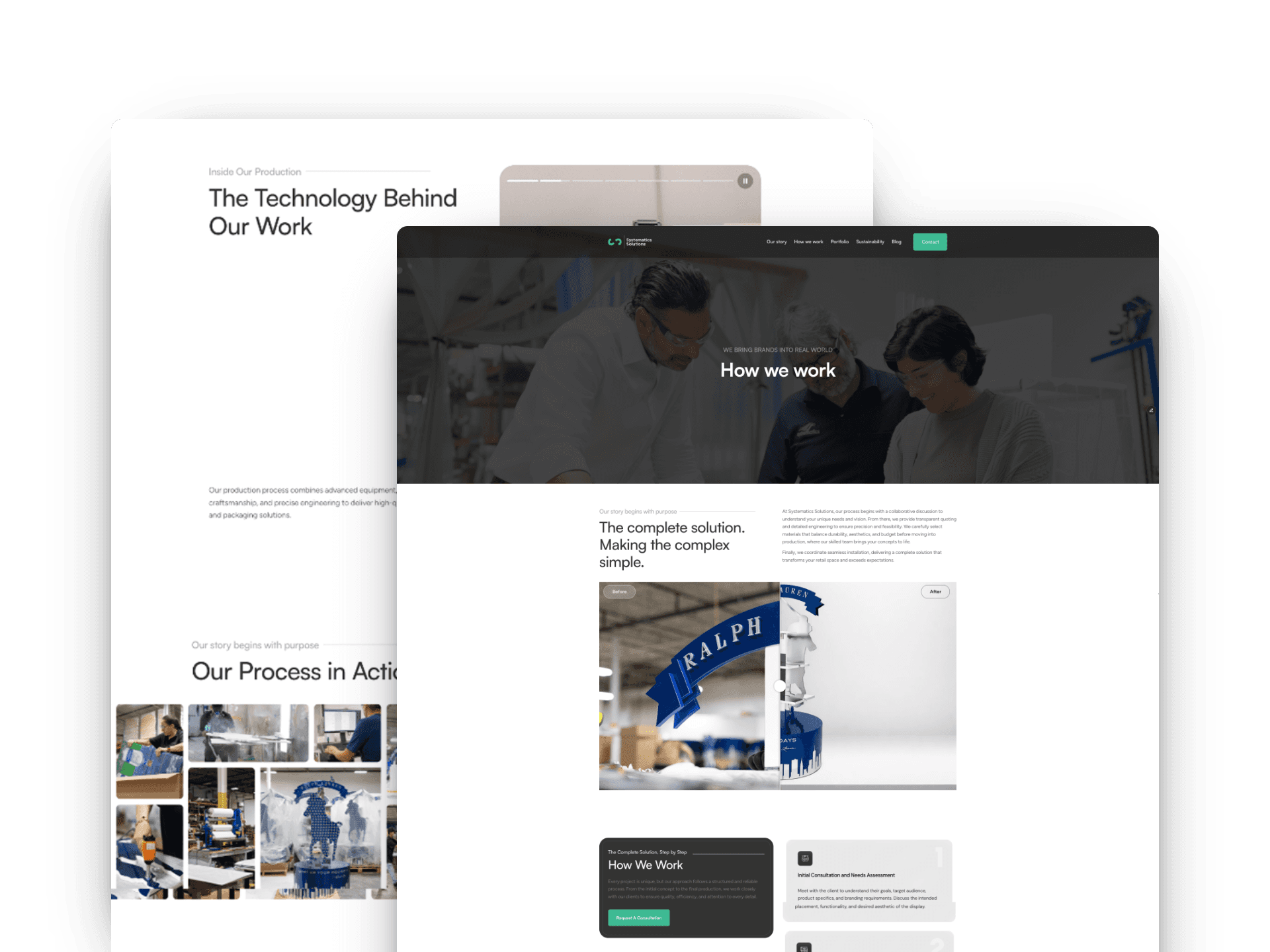
Instead of listing services, I built a dedicated "How We Work" section that walks through the entire production process step by step. Seeing the workflow — not just being told about it — is what turns a visitor into someone comfortable requesting a quote. It reframed the site from a list of capabilities into evidence of how the company actually operates.
( 00-02 )
PORTFOLIO & VISUAL HIERARCHY
Every service and capability felt equally important to the client, which meant left alone, the page would've tried to say everything at once. Nearly everyone scans before they read, especially in B2B.
I worked with the client to group related content and prioritize what visitors needed first, letting supporting detail reveal itself further down the page instead of competing for attention up top. Long paragraphs became cards, imagery, stats, and timelines. Portfolio became one of the primary navigation destinations, built on a filterable CMS, because most prospects evaluate past work before they'll request a quote — browsing real projects does more to build confidence than any amount of written copy.

( 00-03 )
RESULTS
No analytics from the client yet — results here are about what shipped, not what it drove.
Fully redesigned and launched B2B marketing website Scalable CMS built for Portfolio and Blog content. Reusable component-based design system implemented in Framer. Fully responsive across desktop and mobile. Restructured information architecture that leads with process and proof, not text.
( 00-04 )
DESIGN SYSTEM
There was no design-to-developer handoff on this project, because I built the site myself — which meant the system had to work as a real Framer component library, not documentation for someone else to interpret.
I built a reusable component system directly in Framer: typography scale, color tokens, buttons, cards, navigation, section layouts, a consistent grid, and shared CMS templates for Portfolio and Blog. The goal wasn't a large enterprise token system, it was something scalable enough that new pages and new content could get added consistently without redesigning from scratch every time. The hardest part was keeping CMS-driven Portfolio and Blog layouts flexible enough to hold future content the client hasn't created yet, without breaking visual consistency.
( 00-05 )
RESULTS
No analytics from the client yet — results here are about what shipped, not what it drove.
Fully redesigned and launched B2B marketing website Scalable CMS built for Portfolio and Blog content. Reusable component-based design system implemented in Framer. Fully responsive across desktop and mobile. Restructured information architecture that leads with process and proof, not text.
( 00-06 )
REFLECTION
Owning design and build on the same project showed me where the two disciplines actually create friction, versus where the friction was optional in the first place.
Normally the discipline you don't own is where assumptions leak through — a spacing decision that looks fine in Figma but doesn't survive real content, a component that works for one entry but not the fiftieth. Building the site myself removed that gap, but not the need for the same rigor: the CMS templates still had to hold up under content the client hadn't written yet. It's made me think about design systems less as documentation and more as something that has to survive contact with actual use, whether or not I'm the one implementing it.
( 00-07 )
DISCOVER MORE


